

Too small and you’ll keep buying power from the grid. Too big and you’ll pay for panels your home can’t use. Answer five quick questions and see what size suits your household.
Solar sizing guide for Rockhampton, Yeppoon and the region
How to size your solar system for a Central Queensland home.
Want exact numbers? Upload your electricity bill and we’ll size it from your real usage.
Family-owned and local since 2004
In-house accredited technicians
Rockhampton, Yeppoon & Central Queensland
On this page:
Size calculator
What affects size
Sizes by household
FAQs
Get a quote
What size solar system do I need?
Most family homes in Central Queensland fall somewhere between 6kW and 13kW of solar panels. Where you land depends on how much electricity you use, when you use it, how much roof you have and whether you run air con, a pool pump or an EV.
A simple starting formula: your average daily kWh ÷ 4 = the solar system size in kW you’d need to cover it.
The 4 comes from roughly 5 peak sun hours a day, with about 20% lost to heat, wiring and inverter efficiency. So a home using 24kWh a day starts at around 6kW. It’s a good first estimate, and it’s where our calculator begins too. For a more accurate answer, book an Electricity Bill Check and we’ll work from your real usage.
It's about timing, not just kilowatts.
Your panels peak around midday. Your family’s demand usually peaks when everyone’s home, dinner’s cooking and the air con is running. That gap is why a bigger system doesn’t always save you more.
Extra solar sent back to the grid typically earns a much lower feed-in tariff than the price you pay to buy power later. Sizing around what your home actually uses, and adding a solar battery for the evening gap, is usually smarter than adding more panels.
Not sure how a battery fits in? See how a solar battery works with your system.
Six things that decide the right size.
Two homes on the same street can need very different systems. Here’s what we look at.
How much power you use
Your average daily kWh is the single biggest factor. You’ll find it on your electricity bill, and it’s the number we start with. Send us your bill and we’ll do the maths.
When you use it
Solar only produces in daylight. A home that’s busy at 6pm benefits from a different setup than one that’s busy at noon. That’s where a battery comes in.
Your roof space
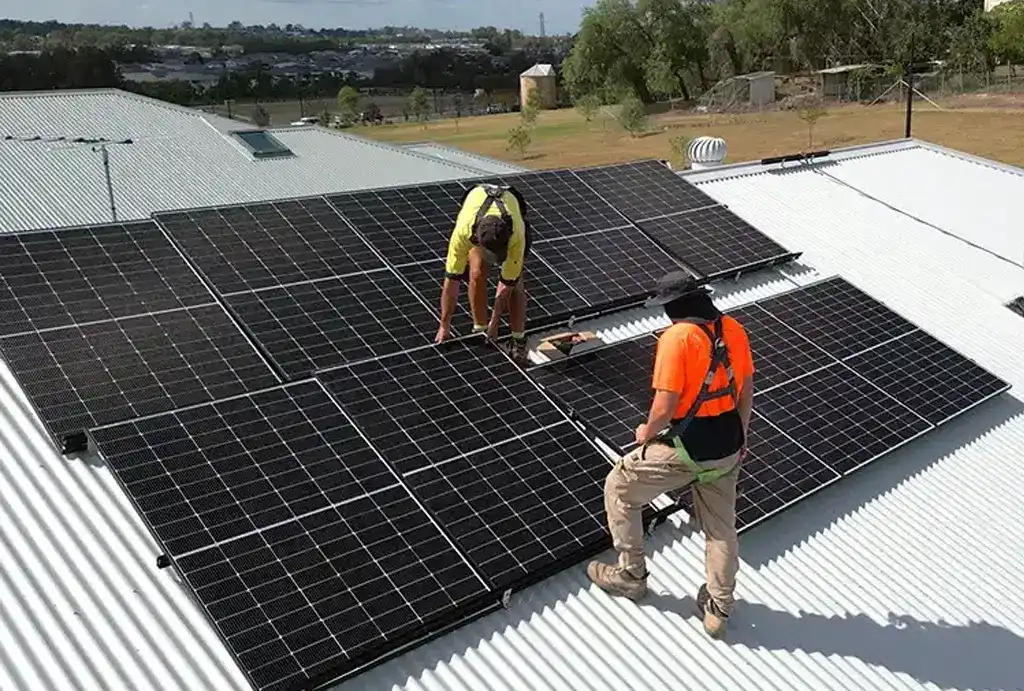
Each panel needs around 2m². Roof size, pitch and obstructions like vents and skylights set the upper limit on what fits. See how we handle solar installs on Central Queensland roofs.
Direction and shade
In Queensland, north-facing roofs usually produce the most, while east and west can suit homes that use more power in the morning or afternoon. Trees and neighbouring buildings can cut output.
Network limits
Your network provider (in most of Central Queensland, Ergon Energy) can limit inverter size and how much you can export to the grid. We check what applies to your address before we design anything.
What’s coming next
Planning an EV, a pool or a battery? It’s cheaper to size for them now than to upgrade later. Ask us about finance options if you want to do it all at once.
Typical solar system sizes by household.
Find the household closest to yours. These are starting points only, so your own bill will tell the real story.
| Household | Daily use | Solar size | Panels | Roof space | Battery to consider |
|---|---|---|---|---|---|
| 1 to 2 people, light air con | 10 to 14 kWh | 3.5 to 5 kW | 8 to 12 | 16 to 24 m² | 5 to 7 kWh |
| 3 to 4 people, air con in a few rooms | 18 to 24 kWh | 5 to 7 kW | 12 to 16 | 24 to 32 m² | 8 to 10 kWh |
| 4 to 5 people, whole-home air con | 26 to 32 kWh | 6.6 to 8 kW | 15 to 19 | 30 to 38 m² | 10 to 14 kWh |
| Large home with pool, EV or electric hot water | 32 to 45 kWh | 8 to 11 kW | 19 to 26 | 38 to 52 m² | 14 to 20 kWh |
Want to know more about the battery column? Read about solar battery storage or see our finance options.
Solar size calculator
Move the sliders and watch your suggested system size, panel count and battery size update instantly.
Tell us about your home
Anything else that uses a lot of power?
Look for "average daily usage" on your electricity bill. It's the most accurate starting point and overrides the estimate above.
Your starting point
Suggested solar system size
0 kW
based on about 0 kWh of daily use
0panels (440W)
0m² of roof
0kWh a day*
Daytime use
Evening and overnight use
Solar generated
If you add a battery: about 0 kWh of your use happens after dark. A battery with roughly 0 kWh of usable storage could cover most of it.
Get exact numbers for my home
*Average across the year, assuming about 5 peak sun hours and 80% system efficiency. This is a general guide only. Your roof, shading, tariff and network export limits all affect the final design, and that's what our Electricity Bill Check works out for you.
How we size your system.
STEP 01
Send us your bill.
Upload it or give us a call on (07) 4927 1144. Your bill shows how much you use and what you pay.
STEP 02
We look at your home.
Roof layout, shading, existing solar, switchboard and what your network allows.
STEP 03
We size it to your numbers.
You’ll see the options side by side, with and without a battery, in plain English.
STEP 04
Get a clear quote.
No pressure to buy the biggest system. If a smaller one suits you better, that’s what we’ll recommend. We can also talk you through finance options.
Keep exploring.
Once you know your size, here’s where to go next.
Solar panels
See how we design and install solar systems for Central Queensland homes.
Solar batteries
Use more of your own solar after dark and add backup for storm season.
Finance options
Spread the cost of solar and storage with finance that suits your budget.
Talk to our team
Questions about your roof, your bill or your options? Our local team can help.
Rather talk it through?
Give our local team a call on (07) 4927 1144
We’ll size your system from your actual bill. No guesswork, no pressure.
Solar system sizing: frequently asked questions
What size solar system does a 4-person family need?
It depends on how much electricity the household uses, but many 4-person homes with air con land somewhere around 6.6kW to 10kW of panels. The most accurate way to size it is to use the average daily kWh figure from your electricity bill, then allow for things like a pool pump, an EV or future battery storage. Try our solar size calculator for a quick estimate.
How many panels is a 6.6kW solar system?
A 6.6kW system is typically 15 panels at 440W each. Panel wattages vary, so the exact number depends on the panels chosen. 15 panels usually needs around 30 square metres of usable roof space. Learn more about our solar panel installations.
Is a bigger solar system always better?
Not always. A system larger than your household can use during the day sends more power back to the grid, where feed-in tariffs are typically much lower than what you pay to buy electricity. A bigger system can make sense if you plan to add a battery or an EV.
How do I find out how much electricity I use?
Check your electricity bill for your average daily usage in kilowatt-hours (kWh). If you have a smart meter, your retailer’s app or online portal may also show your usage by time of day, which helps size both solar and battery storage. Stuck? Send us your bill and we’ll find it for you.
Can I install a solar inverter that is smaller than my panel capacity?
Yes. It’s common for the panel capacity to be larger than the inverter capacity, within limits set by industry standards and your network provider. This can make better use of the inverter, especially in the morning and afternoon. The Clean Energy Council is a good source for industry guidelines.
Does my network provider limit how big my solar system can be?
Often, yes. Network providers such as Ergon Energy can set limits on inverter size and how much power you can export to the grid. These rules vary by location and can change, so we check what applies to your property before designing your system.
Should I size my solar system differently if I want a battery?
Often, yes. Because a battery needs surplus solar to charge, many households choose a slightly larger solar system when they add storage. The right combination depends on how much power you use after sunset and whether you want blackout backup. Read our guide to solar battery storage for more.
How much roof space do I need for solar panels?
A typical panel is around 2 square metres, so a 6.6kW system of 15 panels needs around 30 square metres. Roof direction, pitch and shading all affect how many panels will perform well on your roof. Not sure what your roof can take? Get in touch and we’ll take a look.
Get your solar system sized from your real bill.
You don’t need to know what size you need. Start with an Electricity Bill Check and our local team will look at how your household uses power, what your roof can handle and what makes sense for your budget. Real numbers. Clear advice. No obligation. And if you don’t need a bigger system, we’ll tell you that too.